

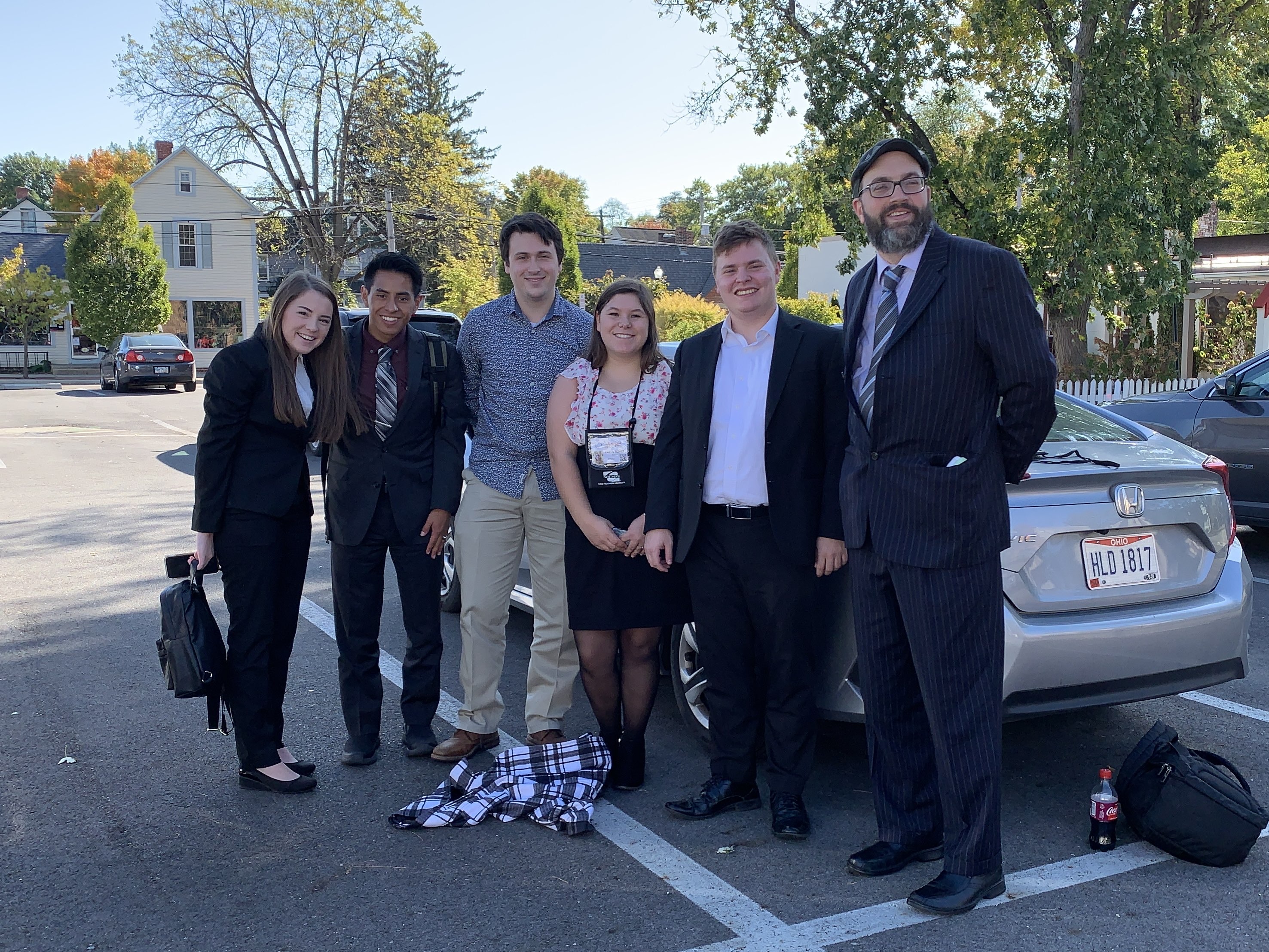
Be meaningful and memorable in what you create. We only understand the impact of what we make now in college once our time here has passed. I feel this theme is a reflection of my time as a student and later a professor in higher education.
My first memory of coming to Ada in January 2014 was going through McIntosh Center and seeing the wire rack filled with the latest edition of the weekly Northern Review papers. Ink on pulp highlighting what the student body thought about the events of the day. It would be hard to imagine when looking at that rack when I arrived what the Northern Review (or even Ohio Northern University) would experience over the next ten years.
A once-in-a-lifetime pandemic that would fundamentally change the way that higher education would function in the United States, social movements sweeping through Northwest Ohio, and national political turmoil marked the past decade on campus and in the minds of all those that I have had the privilege of working with as the advisor for the Northern Review.
It has been ten years since the Northern Review switched from a weekly printed newspaper to the digital news organization it is today. I have had more than a hundred students over that time give their energy and passion to this humble organization. It seems appropriate now to highlight the stories that encapsulate the spirit of collegiate journalism at Ohio Northern University.
The standard version that I have shared with my students about journalism is that it is any mediated work that explains a topic, issue, point of interest, or event of current interest that presents a truthful, compelling narrative about a community to a given audience. The community we have been serving for the Northern Review has been primarily the student body, followed by the faculty/staff/administration of Ohio Northern University and the village of Ada as the secondary audiences, with the alums, perceptive students, and families of students being the tertiary audiences. Good journalism occurs when a story allows the audience to understand the people who influence the story. In contrast, great journalism explains to the audience why they should care about that story. Finally, journalists should follow the ethos and spirit of journalism as defined by journalistic organizations.
I want to highlight the stories (with those ideals in mind) that defined the Northern Review during the last decade.
2014
“I’m a Muslim, and ISIS and 9/11 Don’t Define Me” by Khadijah Bagias
Bagais was the third Editor-in-Chief during the digital era of the Northern Review. This opinion piece spoke to her powerful voice in this media. She was able to articulate an aspect of a national struggle and explain with pinpoint clarity the hows and whys this topic affects her. There are parts of our family lives, upbringing, and experiences that others will never experience. The ability to bring the invisible parts of our lives into our writing so that it resonates with our audience is a superpower journalists have. Finally, I would point to Khadijah’s use of rhetorical questions to drive the dialogue further regarding the mediated perceptions of Muslims. I will never know what it is like to be in Khadijah’s shoes. This story helps the audience gain a piece of empathy for somebody else’s life.
2015
“Salutation Sensation: The story behind ‘Hello’” by Grant Pepper
The beautiful aspect of op/eds or opinion pieces is that the writer can trade some objectivity in service of presenting a compelling narrative injected with personal voice and reflection. I can write this op/ed (for example) to point out that I love this article because it touches on three of my passions. First, it puts the spotlight on a quirky part of campus life. To this day, I still come across the “Hello” meme on my social media timeline, and it makes me smile. Campuses can be boring without local color. The second point is that the campus can come together to take some joy about life in Ada. Dr. Boyadzhiev was a joyful presence on campus. Finally, it talked about memes, which is a part of digital that I love researching. Any story that ends with “Now, back to more cat videos” is going to be memorable.
2016
‘The Shape of Things’: How far would you go? by Elena Coleman
One of the elements of this story that appealed to my sense of journalism is how it frames the story from two different perspectives. Coleman uses Sybil Anast’s quote as a way to present the student’s viewpoint and balances that vantagepoint by getting Brian Sage’s quotes about the presentation. Stories like this one are what I would call a “time capsule story.” We rarely imagine the ramifications of reading a story like this and remembering what we were doing during this time. Elena allows the reader to think about the show if they were around Ada during this time, and those students can now think about what this show would have been like seeing or performing it during this time.
It is a simple and soft history of entertainment at Ohio Northern that is still meaningful today.
I would also put Grant Pepper’s “Finding Peace in the Penalties: Inside the conflicted mind of Dean McNeil” as a story worth noting during 2016. Pepper’s name will appear in this retrospective a number of times for good reason. He was the 2018 Barlow Student Journalist of the Year from the Society for Collegiate Journalists. This feature article was one of the first stories that I felt that he was getting his journalist voice towards the forefront of his writing.
2017
“For Polar Bears, By Polar Bears” by the Northern Review Editorial Board
It is vital every so often for an Editorial Board to take a stand on an issue of importance. This time period saw an influx of critical attacks on the value of journalism. The Editorial Board at that time saw that as a challenge to define them in the face of a national focus on the power of the media in a post-election society. It pointed to the ethical guidelines that drove the decisions that the organization would make with regard to covering the news of the day.
“Through the ups and the downs, Amy Bullimore was built for this” by Grant Pepper
A feature article is one of the most difficult stories to write as a college journalist. We focus on the writing progression as a means to organize the important truths of the story so that there is a sense of flow between those truths and a chance to include quotes to support those truths. Pepper takes the audience into the mindset of the subjects of these articles better than any other college journalist I have ever worked with. There is also a sense of when to shift the focus so that the reader has a rich description of the subject matter without being bored. I would point to how Grant crafts these snapshots of Bullimore’s life through the quotes and connects them together with a solid narrative.
“Sandwiches: A Social Revolution” by Connor Gillmor
Sometimes articles are crafted because the journalist can see the narrative thread and expand it into a beautiful tapestry of the human experience. Other times, the article comes from a one of the many conversations that derails a staff meeting for over an hour. I will let you, dear reader, determine which point of the spectrum this article comes from. Gillmor takes the standard definitional overview of a popular thought experiment to lead us down the culinary trail and make us question the very nature of the food we eat and the meals we enjoy.
2018
“Smart or heart: Being intelligent shouldn’t prevent you from doing what you love” by Emily Richards
Richards’ style of balancing her logical and analytical mind and highlighting the central truths of the story with her pathos as a college student gave us this amazing overview and reflection of her position as a student and journalist. One can rarely write about the passion and maintain a laser-like focus on finding a reflective truth in a manner that does not feel like somebody is journaling the decisions. Emily added a dispassionate filter on these decisions to come to a reasoned conclusion about her academic career at Ohio Northern University.
I was very proud of Pepper for producing this work for the Northern Review. At the time, this format was very experimental for the newspaper. Grant took his skills as the sports director of WONB Radio and ONU3-TV to craft this analysis of the lacrosse team that modeled itself around the “30 for 30” series of shows that ESPN produced. This documentary series rightly won multiple awards from the Society for Collegiate Journalism for its groundbreaking and insightful look at this team.
“Cody Hurley and the art of never giving up” by Grant Pepper
Honestly, a masterclass in feature writing.
Grant hits the ethos, pathos and logos of Cody Hurley’s story by capturing this moving tale of Hurley’s life in a way that I could not. He uses one sentence grafs as a chisel to tap away unnecessary words and thoughts. I found his use of photographs amazing poignant in a manner that was not overly emotional nor unneeded. Great journalism takes the invisible life and makes it known so that it can resonate with the audience and the community. Grant picked the right subject and told the story in the way only he could.
To this day, I still get goosebumps reading this story.
2019
“Why We Won’t be Buying Houses Anytime Soon” by Holly Dyer
I still use Dyer’s article as an example of an effective use of a drop quote in the textbook that I wrote. It is specifically how the following graf that Holly sets a tone:
“It’s no secret that the housing market has changed since the foreclosure epidemic of 2008. The 2008 recession understandably left many millennials associating buying a home with turmoil and financial instability”
and is immediately followed by an ethos-laden quote:
“The Bank of America says, “Remember that the bulk of the current 25 to 34-year-old cohort started their careers during the financial crisis and early stages of the recovery when the economy and labor market were fragile.””
only to be concluded by the rationale for including such a quote:
“It’s hard to know what a good investment is when it comes to housing since the value of a home can fluctuate so quickly. Homeownership isn’t essential to the needs of today’s young adults given that today’s young adults are postponing life events such as getting married or having kids. Renting is more suitable to the needs of millennials because it’s less committal. It also gives us more mobility and career flexibility.”
That is a power set of three grafs in the story.
“2020 Presidential Candidates Battle for Conservative Central Ohio’s Vote” by Nathan Grizenko
This article represents one of my proudest moments as a college media advisor. Ohio Northern University was invited to cover the 2019 Democratic Presidential Debate at Otterbein University. This event is normally in the domain of professional media and journalism organizations across the Midwest and throughout the United States. There were three Ohio universities in attendance. Otterbein had two student journalists covering the debate because they hosted the event. Ohio State University sent two student journalists due to being the flagship institution of the state. Northern Review was able to send three student journalists in addition to the three reporters covering the debate for WONB-FM and a single journalist covering the debate for ONU3-TV, making the total number of student journalists covering the debate from Ohio Northern University seven. It was a late night that the students attended would never forget.
2020
“The Chapel and Its Bagpipe Playing Chaplain” by Michael Berner
My selection of this story in this overview is grounded in the ability of a strong headline to set the tone for the rest of the story. It sets up a quirky image about what the story would contain and allows Berner to take the reader on a journey about the relationship between Ohio Northern University and the United Methodist Church within the guise of explaining how we originally got a chaplain on campus and why Walter and Marian English donated the money to build the English Chapel on campus. It is also a solid character study of David MacDonald’s tenure as Chaplain of Ohio Northern University.
“Coronavirus: Replacing Hysteria with Fact” by Harleigh Bellmann
My selection of this story is based solely on Bellmann’s keen ability to note that this story might have significance to the student body and may impact daily life in the foreseeable future. Harleigh mastered denoting the facts that we knew about the disease before it was well-known to the rest of the country. Bellman uses the right quotes and information to inform the reader in an attempt to make them more aware, as opposed to afraid.
2021
“The Personal Librarians of ONU” by Chloe Lovell
This article is another one of those stories that makes the invisible parts of our daily lives at Ohio Northern more understood. Lovell does a great job flowing between the interview quotes in text form to the point of narrative about how the personal librarians help students on a daily basis. A peppering of photographs also takes Chloe’s words and brings them to life. She also incorporates a soundbyte early on in the article to frame how the personal librarian duties are less of a burden to these dedicated knowledge workers and more of a privilege allowing librarians to give back to the campus community.
“SHIFT, a New Choreographer’s Showcase” by Bekah Lee
Lee was in a unique position when writing this story. Her experiences with the dance program could have caused a conflict of interest in promoting the event. Rather, she took the balanced approach and let the quotes and images of the event speak for themselves. Bekah’s incorporation of the video in the middle of the story grounded the reader into the action that would encapsulate the viewer of these dance pieces. She also managed to describe the awkwardness of attempting to create an experimental performance piece in the era of COVID-19.
2022
“Austin McCoy on Esports: Staying Valiant in Valorant” by Arin Wade
Wade promotes her expertise in the format by doing three technical aspects of journalism well. Arin first gets to the heart of the story by connecting McCoy’s childhood passion to why he is successful as a Valorant player. Those background tidbits help ground the humanity of the story. The next aspect is the candid photographs that present the article as “a day in the life” of a college esports athlete. Wordplay in the headline is the last element that works with effectiveness. It plays on alliteration while using strong action words to highlight the article’s key points.
“Family, Then Everything Else: Coach Nat St Laurent” by Alexis Woody
Woody’s skills as a videographer are on display in this article. Alexis is able to weave in the video with the coach’s words to craft a feature article about how a stalwart of Ohio Northern athletics became a celebrated figure in the Major Lacrosse League. It would have been really easy to make this feature article assignment a Wikipedia article of Coach St. Laurent. Instead, we gained insight into the man.
“In Defense of Ohio Northern University” by Gabriel Mott
Mott reminds us that “pessimism is easy” in the opening salvo of his op/ed article. He does what all good opinion writers do in this format. Gabe paints a textual image of his community to explain through their recorded snapshots of written reality that highlights an area that the community should focus on as either a point of civic pride or a place that we need to come together to improve. He offers both in this article. Mott states clearly in the drop quote:
“Our criticisms aren’t meant to discourage the student body; they’re meant to better the institution.”
College media organizations can be seen as a nuisance, only focusing on the negative for the benefit of crafting stories. A thoughtful organization realizes its role in campus life is to assist the university in becoming the best version of itself by being the voice typically unheard under the glossy pages of its promotional flyers.
2023
“Town Hall with President Baumann: What You Missed, and Why It’s Important” by Gabriel Mott
One of the ways that the Northern Review serves the student body is by being the record for important events that will impact the entire campus community. It was with this purpose in mind that Mott highlighted the significant talking points that President Baumann discussed during this town hall hosted by the Student Senate.
This reporting from the event allowed for a transparent overview of the administration’s plan for handling university finances and how Ohio Northern University would focus on its future. It also pointed to how the President’s Office would maintain the traditions of the university while giving some flexibility for future success.
“Debate: College Democrats V College Republicans” by Northern Review Staff
It was at this event that the Northern Review started to take its role as a civic organization seriously, becoming a platform for the leaders of student political thought to come together and exchange ideas in this forum. The College Republicans and College Democrats used the debate format to hash out their platforms and explain to the student body how their positions are relevant to a student’s daily life. It was also one of the first events we could stream.
“The truth about roofies: Easy to obtain and easy to be dosed” by Arin Wade
The area of how drugs affect a local community are often one of the most difficult stories that a journalist can write, especially a student journalist. Wade could take her knowledge and connections with the College of Pharmacy to explain how these drugs impact the human body and address the ramifications after recovering from being dose. Her advice of “Be safe out there, Polar Bears” still holds true today, and you never know who could be a threat and what tools a person has to harm you.
2024
The beautiful part of our news organization is that students have a chance to “slow-cook” the work they are doing. I would rather students take the time to get to the heart of a story in service of explaining to the audience why they should care about the topic they are covering. Kirchner and Mott did this with their in-depth look at “third spaces,” those spaces that are not our homes or work, but represent a place where we become a community. If the argument is that Ohio Northern is a community, then it is important to know what spaces on campus allow us to do that.
“ONU Celebrates the Eclipse” by Gabriel Mott, Evelyn Megery and Anna Kate Jackson
Going back to the theme of the Northern Review being the paper of record for once-in-a-lifetime events, I am very appreciative of the work that Gabe, Evie, and Anna Kate did running all over the Tundra to capture these images that are now part of the permanent record of a rare moment when the entire village was looking up and in awe of the power of nature and the beautiful of a mid-afternoon twilight.
“Here’s how we would Spend Ohio Northern’s Money (Probably)” by Gabriel Mott
In a way to conclude my review, I think this last article hits all of the themes from this retrospective well. Gabe is able to take an analytic view of an issue that impacts the entire campus community and translate those numbers into a narrative that explains where we are currently and where we would like to see ourselves. It uses the interactive infographic tools well to engage the audience to think about the resources that we share and how we can best use them.
To conclude this long retrospective of the first ten years of the digital era of the Northern Review, I have felt a sense of pride for how my students cover the events of the day and present them with an honest voice that can be overlooked in an era of social media snapshots of reality. This retrospective also allowed me to reflect on each of the stories that I highlighted and remember where I was when I was either helping the student journalist with a technical question about the journalistic process or conducting a review of how to improve the quality of their work. Often this gaze into the journalistic process would be a simple statement.
“Golly gee, that sounds like an op/ed to me.”
It also reminded me of the journey of my beard from a solid black mat of curls to the salt-and-pepper construction it’s become. Each one of the grey hairs has been earned, thanks to the wonderful discussions with the Editors-in-Chief that I have worked with during my tenure. It’s been my honor to mentor Sam Ventrella, Joey Ferraro, Khadijah Bagais, Kasy Long, Nick Pesetsky, Nathan Grizenko, Connor Gillmor, Kayla Fisher, Doug DeNoi, Eldon Buckner, and Gabriel Mott and led them down the pathway.
And I wouldn’t trade the journey for the world.