

ONU has a record of admitting students with competitive high school GPAs.
35% of incoming students were in the top 10% in 2014. I was a part of the 2014 statistic. My high school teachers told me that I could be very successful in a math or science-related major because these were subjects in which I seemed to particularly excel. I liked math and science a lot but also enjoyed classes like writing and journalism, so choosing a college major was a tough decision for me.
I decided in the end that math and science were the only ones that would be worth my time. I was a female who excelled in these areas, and I figured pursuing a career in writing would be a waste of that ability. Plus, it wasn’t guaranteed to pay the bills.
So I aimed high.
I enrolled as a biochemistry student at ONU because I thought it sounded like a challenging major at an acclaimed university. I was raised to always accept a challenge because if I didn’t, I would never know what I was truly capable of achieving.
I planned to go to medical school or grad school and pursue a career in research with my degree in biochemistry. I wanted to prove to myself that I could excel in such a difficult field, especially as part of the female minority.
I feel that I did prove this to myself, as I managed to keep a good academic standing over the years despite taking challenging courses. I realized, however, that something important was missing.
I wasn’t really enjoying myself. Science started to feel more tedious than enjoyable, and telling people about my major became more of a reflex than something I actually wanted to talk about passionately.
I did not marvel at the idea of being a scientist for the rest of my life, but for some reason, I kept telling myself that I did. I changed my major to chemistry when I discovered my fear of blood wasn’t exactly an ideal propellent into the medical field.
A lot of my new classes were interesting on the surface level, but I didn’t find myself wanting to know more. I hated going to labs and hated the lab reports even more (but I guess who doesn’t hate lab reports?).
I soon had to face the fact that maybe science wasn’t for me and that’s when I realized what my mistake was. I suffered from the misconception that being intelligent meant that I had to pursue a hard science in college.
I wanted to return to the subjects I had shoved away when I reasoned that they would be a waste of intelligence to pursue if they weren’t math or science-related. I found myself missing the writing and journalism classes I enjoyed so much in high school and realized that I wanted to continue learning about these subjects. I wanted to write something that wasn’t a lab report.
So I did something about it. I added a multimedia journalism minor to my chemistry major and began taking classes in journalism. I discovered that being a good journalist doesn’t just require you to be a good writer but also to be proficient in photography, speaking, design and videography, activities that I also enjoy outside of writing.
I thought I had a solid grasp of the concepts of journalism but soon realized that I still had so much room to grow and so many different aspects to challenge me. I was having so much fun pursuing my passions in writing and other disciplines that my misconception about having to study science soon dissolved.
To be clear, I don’t hate science, and I don’t hate chemistry. I think it can be incredibly interesting to learn about, and I’ve found an appealing way to apply it through mentored research in environmental chemistry. I also have a lot of respect for females in science. My female classmates and professors are some of the most intelligent people I know.
I decided, however, that there were disciplines outside of chemistry that I enjoyed more.
The fact still stands: I will graduate from ONU with a degree in chemistry in exactly one semester. I am okay with this. I have learned a lot of valuable skills and applications through the ONU chemistry department, but now I can comfortably tell myself that if
I don’t want to pursue a career in science, if I want to be an author or a journalist, then I can be.
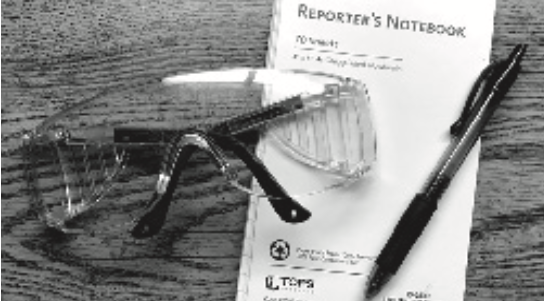
Being intelligent doesn’t mean that you have to go into a hard science and, for me, being challenged didn’t stop just because I traded in the goggles for a notebook and a pen.