

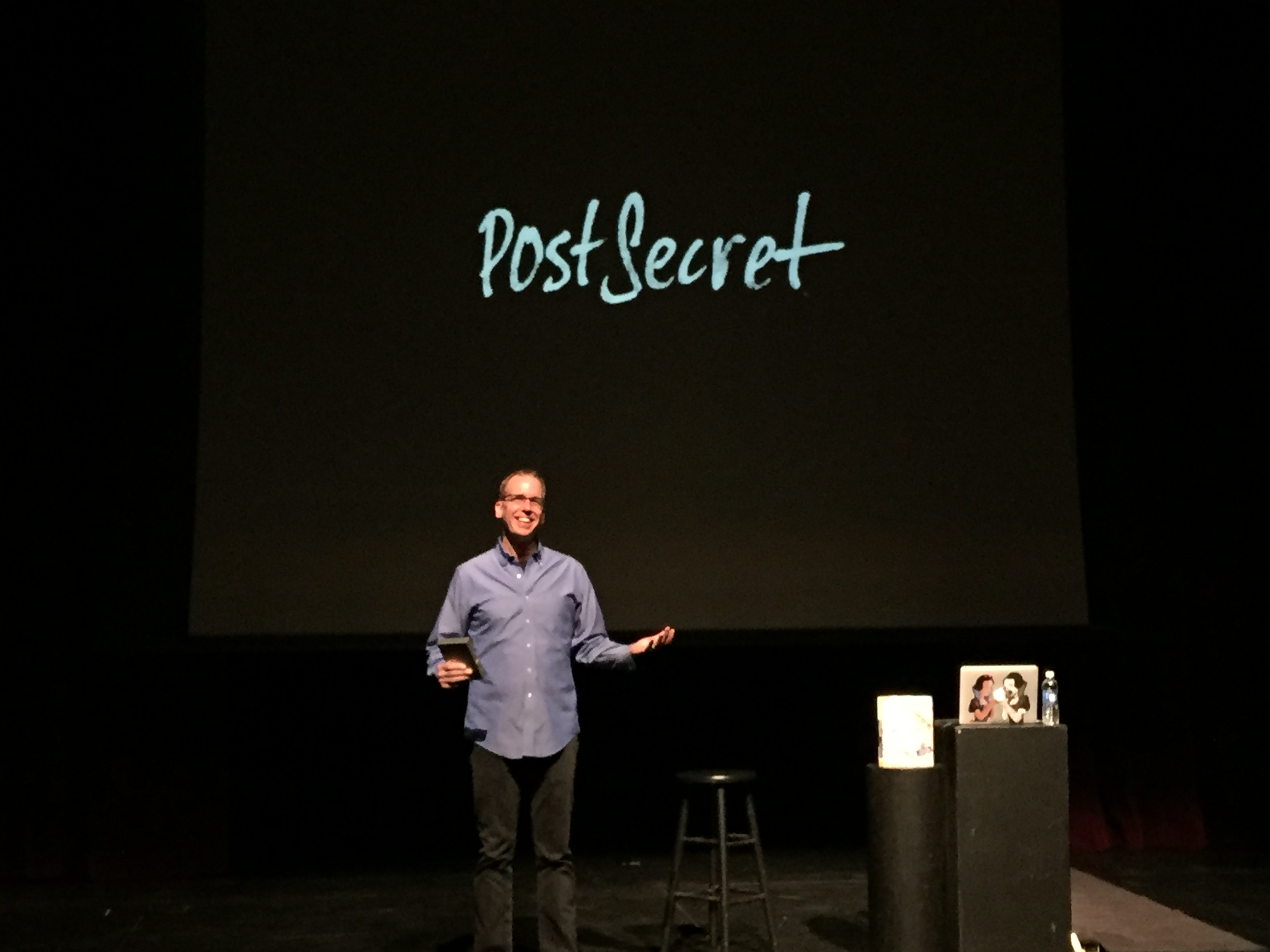
Frank Warren wanted to leave one central message to those in attendance in the packed Freed Center theater.
“You keep a secret inside of you and it feels like this wall, separating you from others. But if we can find a way to let them go…we can recognize that secret was really a bridge the whole time.”
Frank Warren, who is the founder of PostSecret, was invited to come to Ada by multiple groups on campus including: the Cultural and Special Events Committee, the President’s Office, Department of Communication & Media Studies, Department of Psychology, Sociology & Criminal Justice, & the Freed Center for the Performing Arts.
This invitation led to the audience experiencing a shared emotional discussion as Warren highlighted the many secrets that we may share, and gave members of the public a chance to share their secrets during the open mic session at the end of his talk.
The majority of the discussion focused on PostSecret, a project designed to share the secrets of strangers through anonymously sent postcards. Warren started this project in 2004 by handing out over 3,000 postcards to strangers in Washington D.C. and hoping they would share their secrets.
“The reason that I wanted to do this was I was looking for an outlet to share my own secrets and my own pain,” Warren said as he showed a postcard featuring a door with a hole that had resulted from a punch.
The secret shared on that note indicated that the person’s mother had made the hole. “I realized that I had a door like that when I was a kid,” Warren later explained. He then went on to highlight how the PostSecret community related to that image as well. Nearly one million visitors went to the site the day the day that postcard was featured, with many others sharing photos of their doors with holes in them.
It was then that Warren realized that he was connecting with larger, social truths. He pointed out how we oftentimes feel like we’re the only one harboring a certain secret, but when we let that secret out and share it, we not only find that many more have also experienced the same, but that the secret is no longer a secret and it loses its power over us.
These more important social truths are one of the reasons that the community comes together and is so powerful.
Warren pointed to another series of PostSecret secrets of a person that wanted to deal with their pain by standing in the middle of a busy street and “will[ing] a car to hit them.” The posting showed a picture of a street in England, where that poster was. Once the PostSecret community saw that picture, two people replied, one of them telling the person that sent the original post that they could come to their house just down the street and talk about their pain. During one of Warren’s shows in England, Warren showed this photo on the screen as he was presenting. The person who sent the original post was in the audience, and leaned over to tell her friend that she was the one who had sent that post.
Warren finished the story with “the friend [then] leaned toward her and told her ‘I’m the one that sent the reply back.’”
The conclusion Warren made was that people were trying to help one another through anonymous communication, oftentimes not even realizing that they knew each other in real life. He used this as an example of how people do want to help, but oftentimes we are too afraid to reach out to them for that help.
Warren emphasized the importance of simply reaching out and asking how our friends are doing, citing it as one of the most effective ways of showing those struggling that we care. He said that as a result of just getting in touch, people have prevented the untimely deaths of many.
The strongest moment of the night was at the end of Warren’s talk during the open mic session of the show. Audience members came in front of the microphone and told their secrets to the larger audience. The public could hear tears as one audience member after another came and bared their fear, sadness, and point of embarrassment to the assembled masses.
In the end, the sharing of secrets built bridges within the ONU community. Those bridges were created by the ability of the community to care for one another.