

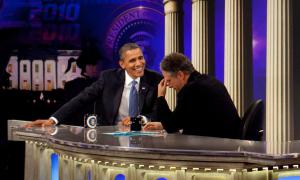
Jason Jones announced on Tuesday that he was leaving the Daily Show to work on a new sitcom on TBS with his wife, Samantha Bee. This was two after Jon Stewart announced that he was leaving the Daily Show Feb. 11. It was thought the Jones could replace Stewart as the host of the Daily Show. With fewer and fewer of the correspondents willing to take over the hosting duties of the show, it seems that by the end of the year the Daily Show will have a new voice and new direction. This seems to be a great time to discuss Jon Stewart’s and the Daily Show’s impact on modern media. It may be better to talk about what’s role is not played by the Daily Show with Jon Stewart.
Jon Stewart is not a journalist. Jason Jones is not a journalist. The Daily Show, for all of its optics as a “fake news organization,” is not reporting the news. The functions of reporting the news is covered by the professional news organization that the Daily Show uses to gather its material. The fundamental process that the Daily Show uses to produce a show is different the process that a news organization uses to produce a nightly newscast. Stephen Colbert talked about the process from start to finish.
The best argument that be made about Jon Stewart’s role in the media is that he is good at holding the media accountable. The most popular bit of evidence to support this claim was his 2004 appearance on CNN’s Crossfire. Paul Begala and Tucker Carlson invited Stewart on the show to promote America: A Citizen’s Guide to Democracy Inaction. Stewart took this opportunity to call out the two hosts for being part of the political system and for “hurting America.” His critical analysis of the show was supplemented by his trademark sense of humor and irony. Crossfire was cancelled two months after Stewart appeared on the show. One of the reasons that Jonathan Klein, the president of CNN, gave for cancelling Crossfire was Stewart’s appearance.
Another example of Stewart’s ability to influence the public’s opinion toward the media was in 2009 when the Daily Show focused on CNBC and specifically Rick Santelli for the decision of “subsidising the losers’ mortgages”. Stewart spend a week poking holes in the logic and the tone of CNBC. He questioned CNBC’s position of being “irresponsible cheerleaders” of the stock market instead of the watchdogs for the American people. The criticism became so problematic for CNBC that Jim Cramer, one of the more popular hosts on CNBC, appeared on the Daily Show to address the condemnation. Cramer’s appearance on the Daily Show was described as Stewart beating “Jim Cramer’s sorry ass.”
Beyond holding the media accountable, the Daily Show acts as a central hub of cultural awareness. The interviews conducted by Stewart range from the political to the popular. The audience that watches those interviews are what the Pew Research Center would call “highly informed.”
Jon Stewart will be gone from the Daily Show. It will be interesting to see if Stewart’s replacement will keep the show going in the same direction as it currently or if there are new ways to combine humor and critical media analysis. Only time will tell.