

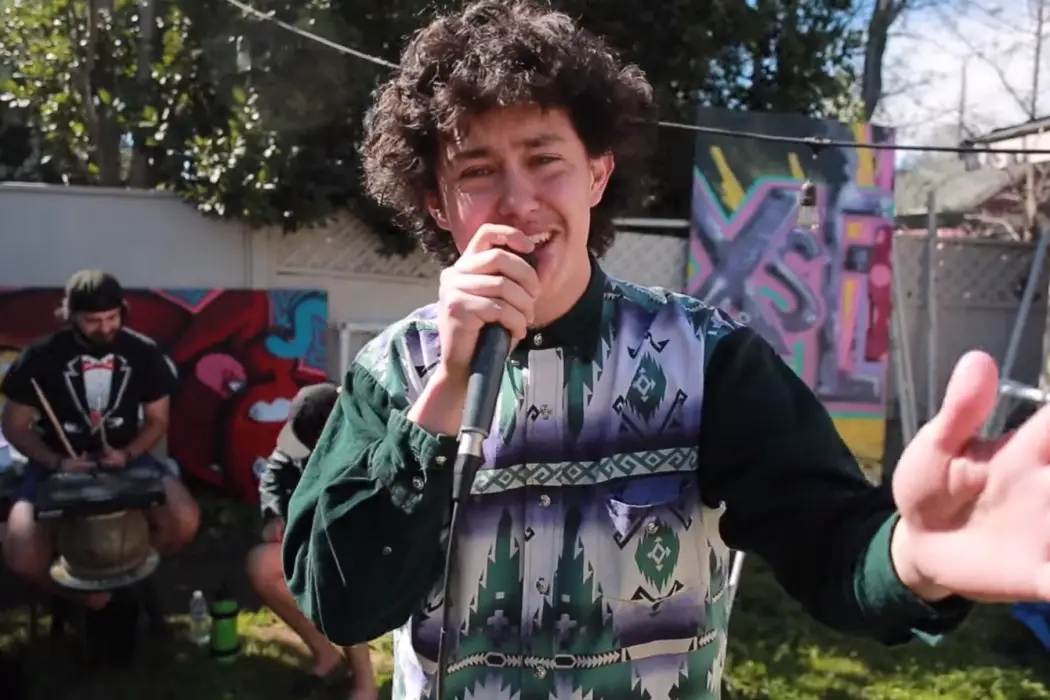
On March 7, 2018, a musician by the name of “Hobo Johnson” released a video submission to NPR’s Tiny Desk Contest. The video, which features a table rather than an actual desk, has raked in over 4 million views on Youtube and over 9 million views on Facebook.
The song in the video, “Peach Scone,” is the narration of a boy in love with a girl who already has a boyfriend.
To mask his true feelings to her, every time he wants to tell her how he feels about her, he instead describes his love for scones. Later in the song, when Hobo Johnson is talking to her boyfriend, he tells him about how much he appreciates her, and calls her a “peach scone.”
The depth of this off-beat representation of love and emotions is one that didn’t immediately register with me when listening to the performance.
Alongside trying to follow Hobo Johnson’s lyrics, I had to acclimate myself to his staggered breathing and rhythmic speech. Hobo Johnson’s music is less music and more slam poetry than anything.
Even so, “Peach Scone” isn’t like the kind of poetry you’d see on a video shared by Button Poetry. His music is the sort of slam poetry that’s a mixture of conversation, tangents and thoughts spoken out loud. In a way, his performance meshed together the poetic rhetoric of William Shakespeare while mimicking the vocals of an alternative rock band. Despite all this, Hobo Johnson classifies himself as a rapper-sort of. In Peach Scone, Hobo Johnson says, “My name’s Hobo Johnson, I’m a rapper- I’m actually not a rapper, I like to say a musician. I play guitar sometimes too (I’m just not as good as Derek.)”
The Derek mentioned is the guitarist in the video, a member of “the Love- Makers,” the background musicians that supplement Hobo Johnson’s vocals.
Hobo Johnson is yet another example of society’s interest in so-called “Soundcloud Rappers”- rappers that are self-produced and self-sustaining, yet adored by millions.
Soundcloud Rappers are no longer dependent on record labels like the musicians of previous eras because they are dependent on the social media outlets used by mostly everyone in the modern day.
By posting to Youtube and Facebook, Hobo Johnson, and other musicians like him, have achieved in a month what would have taken years of networking, advertising and touring as recent as a decade ago.
Musicians like Hobo Johnson have begun setting a precedent for who participates in the music industry going forward.
Gone are the days of needing a record label and money to become a famous musician. Instead, the story of Hobo Johnson and “Peach Scone” have shown that all you need to become famous is a video camera, a backyard and a tiny desk.