

Instinct. Intention. Impact.
There is no room for hesitation in sports photography. The perfect action shot will come and go in a blink of an eye, never witnessed again unless you, the photographer, capture it in your lens.
The pressure to get the perfect shot only intensifies as you take in the surroundings: sunlight piercing through stadium bleachers, crowds roaring with passion, and a battle unfolding across the field. Life-changing moments are happening a mere distance away from you. What do you focus on? Whose story deserves to be told? Which moments are worth preserving?
Instinct. Intention. Impact.
Timing is everything when the perfect shot can vanish in an instant. A sports photographer must intuitively know where to point the camera and which stories are important to share. Modern camera equipment takes dozens of photos within seconds, but it is patience and skill that secure a truly impactful image.
Maintaining creativity in a high-speed environment is difficult to achieve. Diligent practice and a passion for storytelling is critical to capture meaningful pictures in a complex setting.

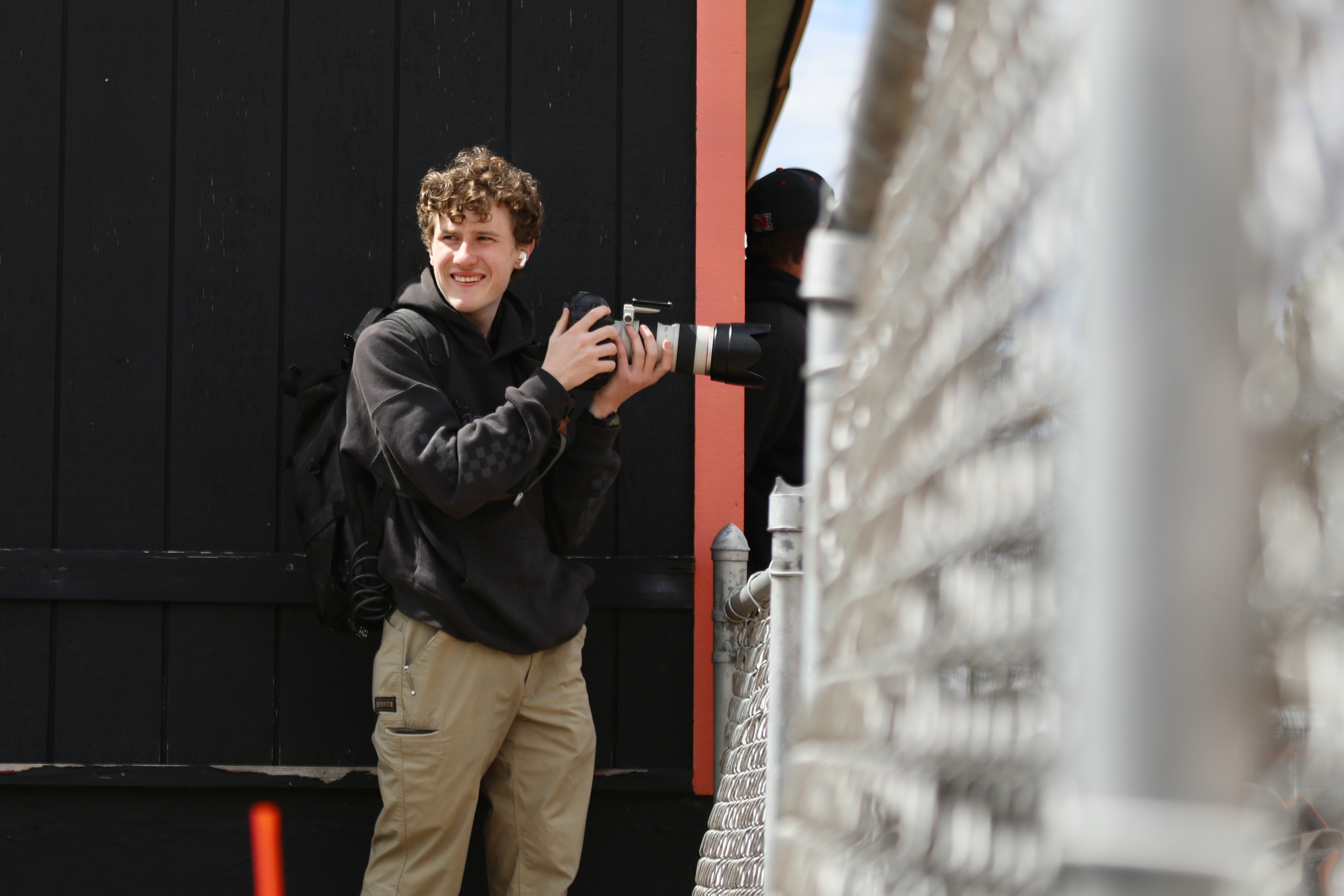
First-year student Levi Fouss accepted the challenge of sports photography years ago. What started as a high school hobby transformed into a steady position in Ohio Northern University’s (ONU) Sports Information Department.
Contributing to ONU’s athletic program was an adjustment for Fouss. Collegiate sports bring a higher level of competition, and therefore a heightened demand for professionalism. Fouss was no longer a photography enthusiast; he was responsible for documenting the university’s pivotal sports moments.
Old habits were cast aside as Fouss took on his new role. He learned how mindfulness behind every photo is crucial for efficient picture taking. This practice is a stark contrast to Fouss’s early days when he would shoot cameras in burst mode, continuously shooting in hopes of getting one usable image: “… I kind of just sprayed and prayed.”
“I didn’t think, really, about my shots,” said Fouss, reflecting on his early photography days. “I overshot a lot. Now I pick from moments that I want to photograph, and I’m a lot more picky about what I want.”
He also shared, “I used to not care about faces as much. I almost always have a face in the picture now just because it brings the emotion into the picture.”
Emotion—that is where the heart of photography truly lies.
An image displays not just what is happening, but why the viewer should care. An artist can capture a stunning silhouette, a vibrant flash of color, or even a captivating action shot, but it will mean little without displaying a compelling story.
Nothing can compare to the expressions that play across the face of the subjects, whether it be concentration in a challenging matchup, joy after a victory or frustration from a disappointing loss. Those emotions can be relieved through powerful images that vividly show the faces and actions of those in the frame. Pictures devoid of emotion have no story to tell, and that mindset shaped Fouss’s view on photography.
“A good sports photo is action without emotion. A great sports photo has action and emotion; it tells a story. It makes the viewer think something, like ask what’s happening or ask a deeper question and take more than a 10 second glance at the picture.” – Levi Fouss
Director of Sports Information Tim Glon knows the importance of a great sports photo. As the official records-keeper of all things athletics, Glon is responsible for tracking statistics, contacting the press, and documenting every sports event on campus.
Photographs are a special kind of artifact in the sports archives. The department can access decades worth of images to revisit some of the university’s most pivotal sports moments and honor current students and alumni who have permanently left their mark on campus. Glon frequently receives calls and emails asking, “My grandfather played football in the 60s. Do you have a picture of him?” It is the responsibility of his department to organize and provide those cherished records for the Polar Bear community.
“We take [photography] very seriously here,” said Glon. “I think photography is a great snapshot of that exact moment in time, right? That’s why we try to have photographers at all of our events … and we try to run a picture of that event because that’s the snapshot of that moment as far as like, we wore orange this day, it was sunny out, the other team wore this, it was cold, there was snow, you know, so you can see a visual of what the game looked like …That all is part of the historical record of that event.”
Photographs are easy to acquire in a digital age where anyone can take a decent picture. Sports, however, require a particular skillset that accounts for the high-speed action, variable lighting and vast distances covered. Glon recognizes the importance of having dedicated photographers covering athletic events and trains students to meet the department’s high demand for quality pictures.
“I mean, you could just send a random person out with our equipment and they might get something we could use, they might not,” said Glon. “But for the volume of photos that we run on our athletics pages and, you know, for our purposes for historical records, boy, we really rely on students and it’s worked great for us. It’s been a fantastic partnership over the years.”
Sports photographers such as Fouss are students first and foremost. Beyond the academic rigor are artists who enjoy thrilling athletic competitions and the challenge of capturing the heart behind what it means to be a Polar Bear at ONU.