


This article is, in every way possible, unnecessary.
Students, faculty, and staff alike disliked the policies governing the use of the student-l email list and the daily ambush of our inboxes it allowed, so the university changed their policies and we’re now, collectively, much less burdened. Some students have appreciated the difference in how uncrowded their inbox has been. Those who habitually delete anything with the prefix “[ONU List]” may not have particularly noticed, and others have simply never checked their school email in the first place. That’s the end of the story.
Still, towards the end of last semester I couldn’t help feeling that something was off. The email situation was noticeably better than fall semester, but between the mass aggregation of organizational events, faculty sending emails which used to be the domain of students, and my personal experiences with the student list, I felt further investigation was in order.
Over the summer, I have carefully catalogued every student-l email in my ONU inbox sent during the Fall 2024 semester (before the new rules) and the Spring 2025 semester (after the new rules) with the hope to identify similarities and differences that may be relevant to how students choose to manage their inbox, and may even reveal something about student involvement at ONU. One very large spreadsheet, hours of work, and a medically irresponsible amount of caffeine later, here’s what I found:
The Most Important Disclaimer Ever Written by a College Journalist
Before I show you everything I found, I need to clarify that while I am reporting the state of my Ohio Northern inbox, I can make no promises about the state of your Ohio Northern inbox. Although [ONU List] or [ONU Student List] emails reliably reach everyone intended to receive them, I lack certainty that I have captured every student-l email sent last year. I have never been in the habit of deleting student-l emails (and I am now making a more deliberate point of it so that I can expand the scope of this project over winter break), but I’d sincerely like to acknowledge that I may have clicked a wrong button once or twice.
That being said, I am thoroughly confident that my conclusions are valid. As you will soon see, the magnitude of the effect of the new student-l guidelines is well beyond mistake or misinterpretation.
Understanding the New Student-l Guidelines
New guidelines governing the use of the student-l email list were issued via a student-l email from the Office of Student Affairs just a few days before the beginning of the Spring 2025 semester. The email also linked to a feedback form. As reasons for the new guidelines, Student Affairs cites the student-l becoming “overwhelmed with emails which do not always apply to the entire student body or may only pertain to a certain group/organization on campus” and “[many students[] voic[ing] frustration.”
Attached to the email was a more formalized set of the new guidelines along with FAQs. A few simple rules remained, such as the sender of student-l emails requiring a valid onu.edu address, although faculty promoting academic survey research are the only time when individual onu.edu accounts may utilize the list now; all others shall come from office or department-level emails. Many other rules governing the student-l are removed in favor of a new “weekly digest email,” including fundraising and student organization-sponsored events (for a partial reference of past University policy, consider the Solicitation Guidelines given in pages 44-45 of the Spring 2025 Student Handbook).
Complete Student-l Guidelines, as of January 16, 2025
- The sender must be a valid onu.edu email address or an entity affiliated with ONU (i.e. Mercy Health).
- Individuals, including students, will not be able to send emails to the student-l list.
- Offices, departments, colleges and units may send emails to the student-l from their specific email address only (i.e. student-affairs@onu.edu).
- Faculty members must distribute student surveys being conducted as academic research. This is the only exception to individuals being permitted to send information to the student-l.
- Emails that meet the guidelines will be distributed within one business day.
- A weekly digest email with information for meetings, events and fundraisers will be sent on Monday. Information included in the weekly email will be pulled directly from the Northern Network with a posting deadline of Friday at 12:00 PM (noon) each week for inclusion in the weekly digest.
- No advertising for the selling of items or services. This information will be provided in a weekly email to the student-l.
- Student organization sponsored events will not be sent via email. This information will be provided in a weekly email to the student-l. An email may be sent to invite faculty and staff to participate if it is appropriate to also invite them.
- Calendar events will not be sent via the student-l. This information will be provided in a weekly email to the student-l.
- Emails with content regarding a political campaign or public office election at the local, state, or federal level cannot be sent.
- No lost and found. Place lost and found announcements on the ONU App message board.
- No group student absence announcements for University groups. It is the responsibility of the student to notify the appropriate faculty member.
- No advertising for specific course offerings. New courses will be listed on the Registrar’s website.
- All advertising for student employment postings must be sent directly from Human Resources.
- Faculty media interviews and scholarship publications are to be sent to the Office of Brand and Marketing Strategy and not the email lists.
- No confidential or FERPA data is permitted on the lists.
Student-l FAQs, as provided to the student body by the Office of Student Affairs
Why is the student-l changing?
Many students have expressed that too many emails are being sent to the list and the goal is to streamline the information provided to all students.
How can my organization have information sent out to the student-l?
Ensure all of your events, fundraisers and meetings are loaded onto the Northern Network by Friday at 12:00 PM (noon) of each week. This information will be pulled to create the weekly email for the student-l. Please ensure you are reviewing the Visibility for your events. The weekly email will include all events listed as Public or Campus/Invited users only. To review event settings and audience information, you may review the Northern Network Resource Guide.
What will be included in the weekly email?
This email will include events for the upcoming week (Monday through Sunday). Separate sections will contain meetings, events and fundraisers as well as the link to the Northern Network page and any links for fundraisers.
How do you send an email from an office/college/department/unit email address?
Individuals who are a member of a google group/email address for their specific area can also choose to send from this alias. Instructions on how to set up this alias are included here. To view your google groups and review and update settings, visit https://groups.google.com/.
Are there other ways to share information with groups on campus?
An additional list exists to share information directly with organization presidents. If you wish to send an email to all organization presidents on campus, please email orgpresidents@onu.edu.
What if my event gets added after the weekly email has gone out?
We are encouraging student organizations to be proactive in their event planning and advertising to ensure that their events are properly advertised in the weekly email. If your event is added after the weekly email is sent and your event is for a future week, it will be included in the following weekly email. Plan accordingly to have your events approved on the Northern Network by Friday at 12:00 PM (noon) for inclusion the following week.
Can I send reminder emails at the last minute to promote my events?
We encourage student organizations to use other outlets to promote your events. Organizations are encouraged to continue to utilize the social media tags – @ohionorthern and @onu_studentlife to have an opportunity for your content to be reshared accordingly. Emails will not be permitted last minute to promote events.
My organization has a flyer we would like to share with the campus about our upcoming event or program. How can we share this without sending a student-l?
There are a variety of bulletin boards as well as opportunities to hang flyers throughout campus. Please ensure you know the policy for each specific location prior to hanging any items and receive approval if needed. In addition, groups can add their flyer as a hyperlink in the description of their event on the Northern Network.
The first issue of this new weekly digest, the Polar Bear Post, would be sent just four days after the new guidelines were distributed. At the header of the email, the two simple disclaimers “The Polar Bear Post is emailed to all students to highlight the meetings, events and fundraisers on campus for the upcoming week at ONU” and “The Polar Bear Post includes all activities submitted and approved by Noon on Friday each week. For additional information, be sure to check Northern Network.” precede a list of events, all including their date, time, location, sponsoring organization, and a link to the event’s Northern Network page. Events are categorically grouped into “Events” (i.e., primarily student organization events with some hosted by colleges or Religious and Spiritual Life), “Fundraisers,” and “Athletics.” The Polar Bear Post sources its information on events and fundraisers from Northern Network, with the new guidelines advising student leaders who want their events promoted have the event registered on Northern Network by noon on Friday of the week before.
Fewer Student-l Emails During Spring Semester
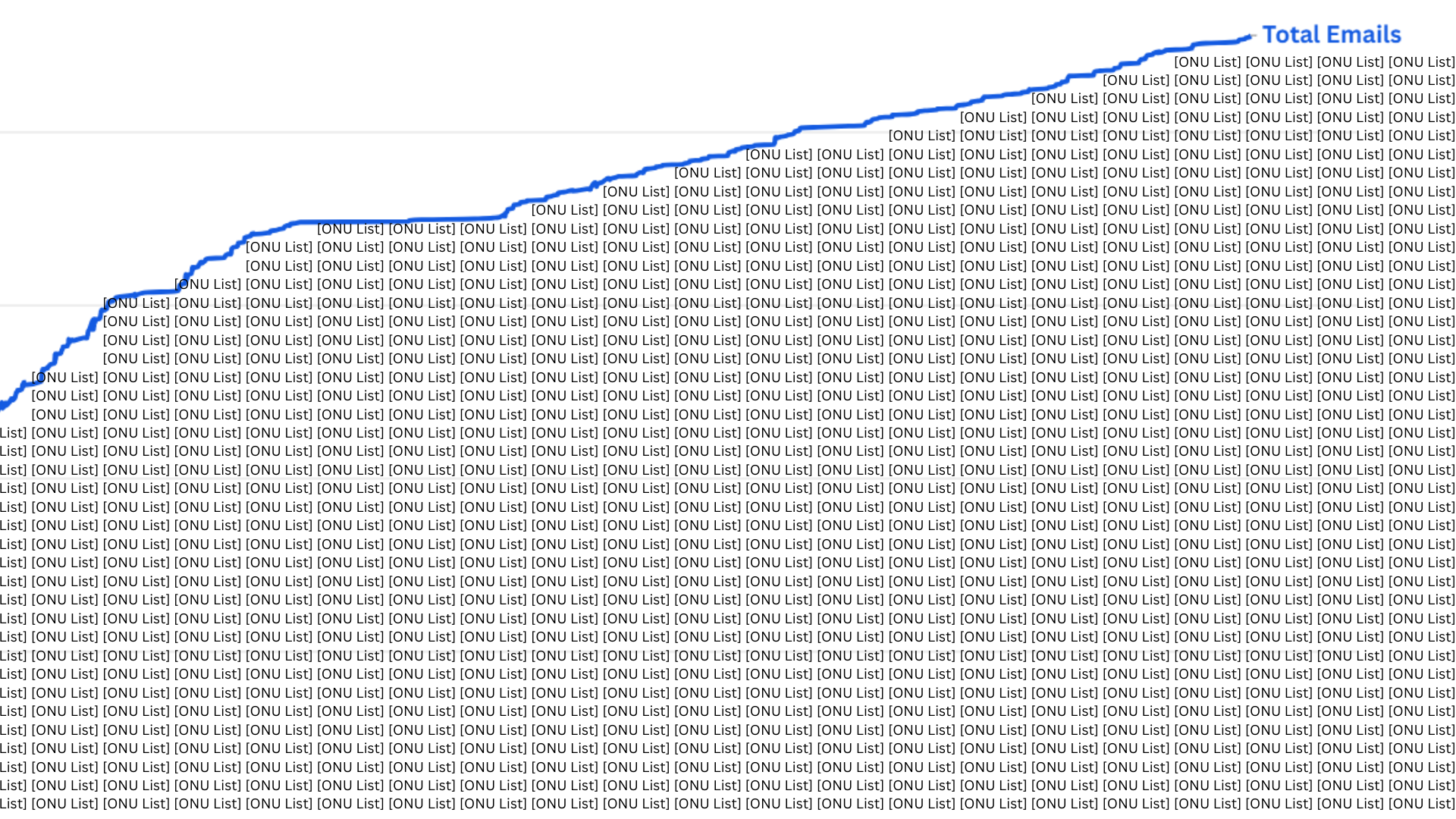
In the immediate sense, the new student-l guidelines worked perfectly. 696 emails during the Fall semester fell to only 210 (30%) during Spring. The chart below provides a cumulative distribution of student-l emails throughout the academic year; the steeper portion during Fall indicates that emails were coming through more rapidly. The period of almost no change occurs during winter break, in which only 6 student-l emails were sent.
This dropoff of emails can be explored for trends by the following two graphs, which display the total number of student-l emails sent during each day and each week, respectively. You can select in the top right corner whether to inspect Fall semester, J-Term, Spring semester, or the entire academic year.
Even considering small local variation, these charts (especially the second which aggregates by week) indicate that not only did Spring semester see fewer student-l emails, it saw consistently fewer student-l emails. Spring semester saw smaller variation week to week in the number of emails than Fall semester, both between consecutive weeks and over the course of the entire semester. This is to be expected, given the standardization of the student-l entailed in the new guidelines. I discuss this in more depth when comparing the time of day at which these emails are sent, but I think it’s a generally good thing to have consistency across the semester in the sending of student-l emails.
The Polar Bear Post (Theoretically) Increases Student Engagement
One positive side-effect (or primary effect, depending on who you ask) of the Polar Bear Post is that a much larger number of organization events were promoted during the Spring semester than the Fall.
A total of 622 unique events and 111 unique fundraisers were promoted by the Polar Bear Post during the Spring semester. This is already more than the 696 total student-l emails sent during the Fall semester, 413 (59%) of which concerned student organizations. I decided to be generous in what constituted a student organization, including Greek Life, Student Senate, SPC, Good News Bears, and the Campus Vote Project (and Northern Review – to all administrative entities, this is not an admission that we are or ought to be subject to student organization restrictions).
The promotion of home athletic events was virtually nonexistent during the Fall semester, including only one women’s volleyball game, one men’s basketball game, one wrestling game, and student-organized sporting events such as “Kick-Off Practice for the Women’s Soccer Club.” The 58 home sports games promoted by the Polar Bear Post easily quadruples that amount.
This is facilitated by the ease in executing the Polar Bear Post, both for student leaders, who are supposed to register their events on Northern Network anyways, and for university administration. Unlike the emails of Fall semester, this provides a sufficient basis for a very rudimentary overview of student involvement itself at ONU (the fundraisers on the donut chart do not double-count the same fundraiser being promoted in multiple editions of the Polar Bear Post):
Of course, this isn’t a necessarily true indication of increased student engagement; the condensed format of the Polar Bear Post also has a few drawbacks. Perhaps most significantly, student recognition of these events requires opening and reading the email itself; under the Fall semester’s chaotic model, one could become informed of the existence of an event hours before it occurs – or even while it occurs – by reading the subject line of an email off of a notification on their home screen. In addition to the increased bar of attention, the Spring semester’s system requires students remember to attend a particular event or patronize a particular fundraiser whenever it occurs during the week, after being informed of it on Monday morning (of course, this disregards the role of social media and word-of-mouth in promoting student organization events, which cannot be underestimated).
Somewhat less substantially, the new format also removes the detail, creativity, and charm from the (e-mailed) promotion of student organization events. Speaking only for myself, I always appreciated the creative use of emojis, color, flyers, and near-infinite variation on “Hello Bears” which gave each organization, and subsequently their event, a sense of personality.
Comparing Distribution of Student-l Emails Between Semesters
Within each semester’s stream of student-l emails, a distribution can be constructed on the basis of both the day of the week an email is sent and the time of day the email is sent (see the graphs below). This reveals a few interesting differences between the Fall and Spring semesters which aren’t immediately clear by considering just the overall frequency.
Monday was the most prolific day of the week for both semesters; this makes sense given the amount of business we tend to conduct over the weekend, then communicate at the next professionally acceptable opportunity. Except for one outlying hour-specific peak on Wednesday for the Fall semester, the average number of emails decreases throughout the week, then drops off almost completely for the weekend. Only 13 emails were sent to the student-l over the weekend in the Fall, and none were sent over the weekend in the Spring.
Interestingly, disproportionately more emails were sent in the morning during Fall, but time is uniformly distributed in the Spring (within normal working hours, of course). Without commenting on the amount of emails itself, I would argue that a more uniform delivery of student-l emails is better; spacing out the delivery of new information makes it easier to read and process each one, rather than opening one’s inbox to many, many more unread emails than they feel motivated to attend to. Students also received student-l emails almost exclusively within standard working hours (9-5) during Spring, which I would understand being appreciated by other students.
The trends in the above two graphs can be combined to produce the following overview of trends both by time of day and by day of the week (clearly separated by the flatlines during night, when no emails are being sent):
Conclusion
Again, this article is definitely unnecessary. But interesting. I sincerely hope that considering a complete picture of your student-l experience (which is, actually, a significant part of your day-to-day as a Polar Bear) helps inform the way you see student involvement at ONU, whether you were one of the students pushing for student-l guideline reform or one of the students actively resisting it