

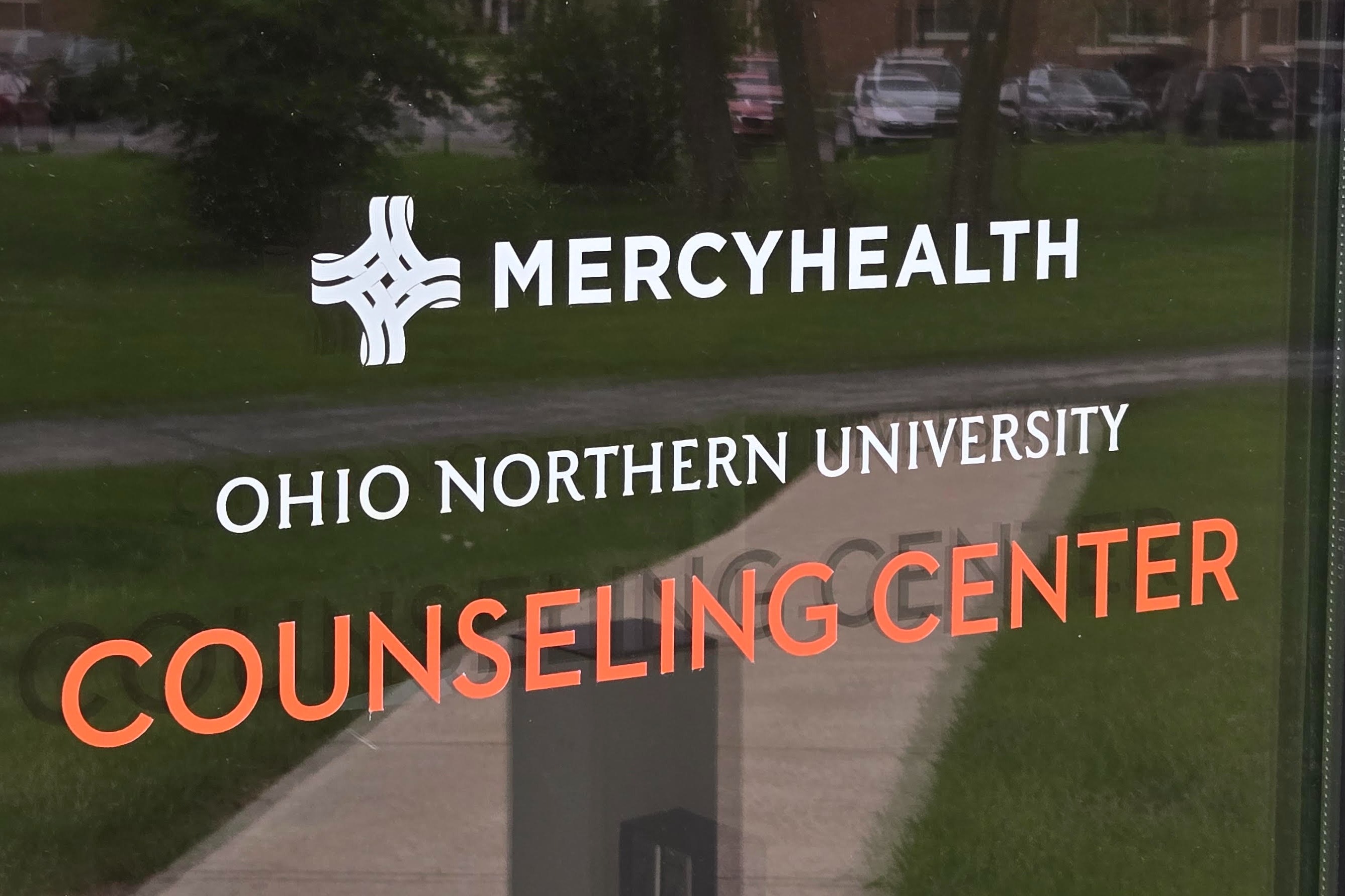

The Ohio Northern University Counseling Center, a student service offered for free in years past, began charging for service at the beginning of the 2024-2025 academic year after partnering with Mercy Health.
The Counseling Center is the most well-known mental health service on campus. The center offers long-term and short-term care, diagnostic services, outreach, and teletherapy, among other means of mental health care.

The ONU Counseling Center’s hours, 8 AM to 4 PM on weekdays, as seen on a window next to the main entrance of the center. (Northern Review Photo/Sam Schneider)
While charging for services may seem like a burden too big to bear for financially challenged college students, there are options to help alleviate financial stress.
For example, the financial assistance form available at the Counseling Center and on students’ MyChart portal takes student income, assets, and insurance information into consideration before potentially providing, as the name implies, additional financial assistance for the services provided by Mercy Health.
“We don’t want any barriers to people using the service,” says Adriane Thompson-Bradshaw, Vice President of Student Affairs. “So we will work with you to make sure that’s not the case.”
The Concern for Student Well-being Referral Form is one of ONU’s free-of-charge services. Managed by the Care Team, a small group of professional staff not managed by Mercy Health, the form acts as a means for students to submit concerns they may have about other students, whether it be a change in demeanor, talks of death, or other concerning behaviors.
The form consists of a series of questions about the specific situation, action, or behavior that was of concern. The form has the option to be submitted anonymously, meaning you will be unnamed to the student for whom the concern was submitted, although the form requires contact information in the event that the Care Team requires more details. Specifics about the concern may also still be shared with the student whether or not the form was submitted anonymously.
According to Marcey Bell, Mental Health Case Manager and Outreach Coordinator for ONU, after a form is submitted they traditionally “start with an email message and move on to text messages and phone calls when necessary. The mode of contact is based upon the severity of the concern. The students are asked to meet with either Jedda Decker or Marcey Bell to discuss the concern and then we will try to connect them to any pertinent resources. If we are unable to contact a student via email, text message or phone call, an in person well-check may be completed.”
The Concern for Student Well-being Referral Form is not used for disciplinary purposes. Reporting concerns about a student’s use of alcohol, drugs, or other activities that may be against school policy does not result in punitive measures against the student of concern; the information provided through the referral is protected and will not result in disciplinary action.
If a student needs help and is engaging in activities that may be harmful to themselves, a fear of repercussions, academic or otherwise, should not prevent them from seeking it.
Same-day crisis services are also still free of charge, available by calling 419-604-3372 or, if calling ahead is not possible, through walk-ins.
Other services are always available to students on and off campus, all detailed in the Orange Folder. The Orange Folder is a collection of resources created by ONU that details a large variety of contact information for various concerns students may have, from crisis situations to pregnancy aid. The Orange Folder is a resource that is constantly being updated and modified. According to Marcey Bell, The Orange Folder is most likely going to be added to ONU’s Wellness Resources page, however nothing is set in stone. If students would like a hard copy of the Orange Folder, they can contact student-affairs@onu.edu next Fall.
Students have access to many resources to help manage their stress and mental health, most of which are accessible through financial assistance or are free. College is tough, and life is tougher, so having help getting through it from a good support system and a team of trained professionals is sometimes essential. Asking for help is okay, and there are plenty of people to ask here on campus.