

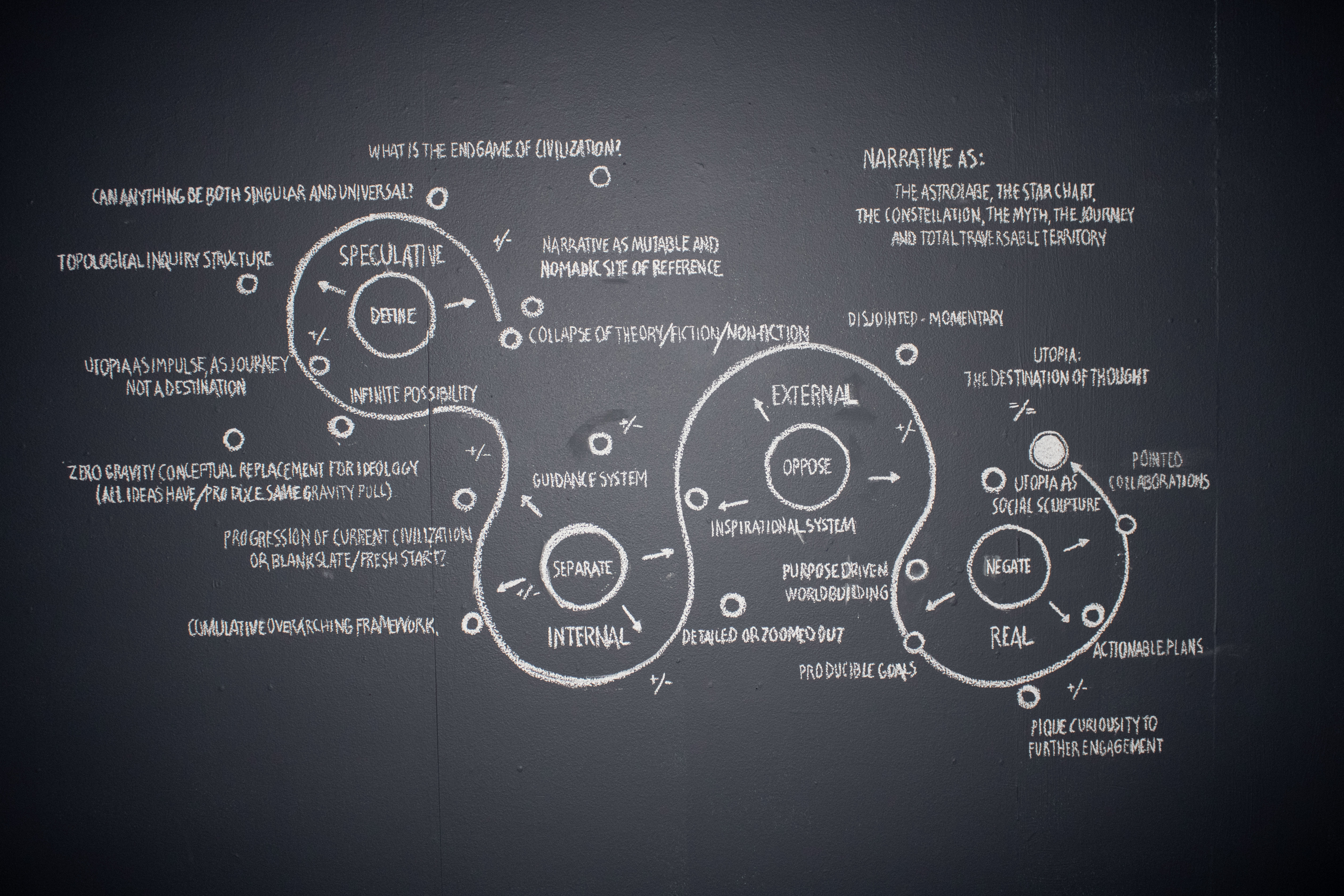

The quest for an ultimate universal experience is a topic that has been brought up throughout history, but Cave Paintings (at Lagrange) by Ian Breidenbach explores this theme of Utopia in a whole new light.
The Elzay Gallery of Art is showing a new exhibit titled Cave Paintings (at Lagrange) by Ian Breidenbach. Breidenbach is a conceptual artist, curator, and educator based in Findlay, Ohio. He is also a current Adjunct Instructor of Art at Ohio Northern University. In years past, the Elzay Gallery hosted a senior capstone exhibit at the end of the spring semester. But with a restructured capstone course, the senior show was moved to January, opening up availability for artists such as Breidenbach to display their work during the month of April this year.
Cave Paintings (at Lagrange) is a conceptual exhibit based on a utopian collective Breidenbach previously ran. This collective was centered around making a document that creates utopias. In exploring this concept, Breidenbach developed the work that is on display in this exhibit.
His work featured in the Elzay Gallery examines what happens when humans start to collect resources outside of Earth’s limits and start using them on the planet. In doing so, humans move “beyond a post scarcity world” and ultimately “build an orbital around the Earth.” That being said, the only way to reach an Earth that is utopian is for humans to leave the planet and view it from a distance, according to Breidenbach.
“The Earth itself is the Utopia but we can’t be there. I think that Utopia is like this huge totalizing thing, but we don’t have the ability to actually produce it so that’s the (at Lagrange) point. The parentheses are bringing in the narrative aspect of this, but Cave Paintings is the historical part of this. Our history started by drawing on walls in caves and then what if our future also begins drawing on walls in caves.”
Ian Breidenbach

The artwork itself is a series of white chalk diagrams drawn onto grey painted walls. Before entering the gallery, viewers are encouraged to pick up a flashlight provided at the entrance since all overhead lights are turned off. This aspect plays a key role in how the exhibit is meant to be seen. Breidenbach shared, “I wanted you to be able to just point a flashlight at a wall and get a small glimpse. Whatever you see is whatever you get at any given time without any way to fully contextualize the whole exhibition.”
Aubrey Davis, a senior studio arts major, shared some thoughts on the exhibit, and her words show how much of an impact the gallery space has on this body of work. “I feel like Cave Paintings (at Lagrange) is really unique compared to other showings at the Elzay because of how it capitalizes on the unique structure of the gallery. The space’s lack of windows and the pseudo-circular nature of the room really made it feel like a cave.”
The chalk pieces Breidenbach used to create his work have purposely been left behind on the floor, prompting viewers to take initiative and add their own work to the walls. “Humans are hilariously audacious and I love that especially for artists. It’s just chalk on walls, go for it. I left all of the chalk on the ground, that wasn’t unintentional. So yeah I like the idea of there being graffiti and then that becomes part of [the artwork] because it’s not necessarily meant for me,” Breidenbach said.
The Elzay Art Gallery is open Monday through Friday from 9am to 5pm and is free of charge. Cave Painting (at Lagrange) will continue to be on display at ONU until April 30, 2025.

Flashlights displayed at the entrance of the Elzay Gallery for the exhibit Cave Paintings (at Lagrange) by Ian Breidenbach (Northern Review Photo/Melina Meza) 
Chalk drawing from Ian Breidenbach’s exhibit Cave Paintings (at Lagrange) in the Elzay Gallery at ONU (Northern Review Photo/Melina Meza) 
Close up of the central utopia diagram from Ian Breidenbach’s exhibit Cave Paintings (at Lagrange) in the Elzay Gallery at ONU (Northern Review Photo/Melina Meza) 
Chalk drawing from Ian Breidenbach’s exhibit Cave Paintings (at Lagrange) in the Elzay Gallery at ONU (Northern Review Photo/Melina Meza)
Editor’s Note: This article has been updated (5/1/25) to correct a misprinted name, which initially read “Ian Brieshechan,” to read “Ian Breidenbach.”