

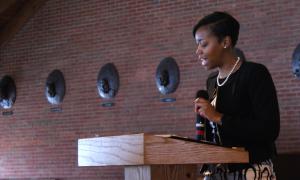
The Office of Multicultural Development held their monthly cultural conversation hour on Feb. 17, in the English Chapel, to provide an environment for dialogue in relation to Black History Month. The topic: The Civil Rights Movement of Yesterday, the Anti-Police Brutality Movement of Today, and Social Justice for the Future. The idea was to incorporate aspects
of what Martin Luther King Jr. represented and fought for, and how society is faring now.
The event started with the Martin Luther King Jr. essay contest winners reading their papers to the audience. From race relations to social justice issues, the students passionately expressed their opinions on the present situation of our country.
Director of Multicultural Development LaShonda Gurley felt that the essayists added a lot more strength to the overall conversation.
“It’s one thing to have the panelists, who are experts in their fields, voice their opinions, it’s one dimensional. To actually hear our students have an understanding of economic justice, social justice, protest…added more depth to what we were discussing.”
A panel of five university professors from varying fields then carried on the discussion.
Theater professor Mark Davis, music professor Charles Bates, sociology professor Bob Carrothers, law professor Joanne Brant and political science professor Robert Alexander were all able to bring in their different backgrounds and make each relevant to the topic.
The discussion wasn’t just about how politics and law affect or are effected by protest, but how areas like music and theater are also applicable.
Alexander spoke of a time when an 88 year-old woman called him to say she was disturbed with the world. He had told her that it was the young people of today that gave him hope for the world, like the students who had shared their passions and thoughts with the room through their essays. Encouraging and having the youth of today understand and care about society and the government is the first step.
“Citizen participation is the lifeblood of democracy,” Alexander said, citing Senator Bob Graham.
Davis incorporated theater into the discussion by citing how social injustices can even be occurrences where people are not able to afford seeing real plays, like on Broadway, because they’re so expensive. It’s limiting younger generations and what they see as acceptable for them to be doing. His personal stories fit into some peoples’ views on how movies and television aren’t very racially or ethnically diverse.
International Services Coordinator Omega Hollies felt that the topic of protest is often difficult to discuss due to its controversy. By having such
a diverse panel with a range of perspectives and experiences, she said it gave students a chance to step back from the emotional aspect of protest and understand the broader social force.
“Protest is sort of a beast. It’s not one thing that you can just study from a particular perspective and think that you’ve got it all down, so being able to provide different perspectives and different aspects of protest I think is one of the best ways to approach it,” she said.
Omega thought that having open, informal discussions like this cultural conversation hour help break ideas down into simple terms that people can understand and appreciate. Too often people are fed sensationalized media they simply ingest, not engage.
“It is an incredibly difficult topic for many to understand; protest being simultaneously challenging authority while establishing authority.”
The hour ran up well before people’s thoughts did, so although there wasn’t time for as much student discussion as they would have liked, attendees carried on the conversation afterward with their friends.
Both LaShonda and Omega said they had hoped more attendee involvement could have been incorporated, and it was something they would work toward in the future.