

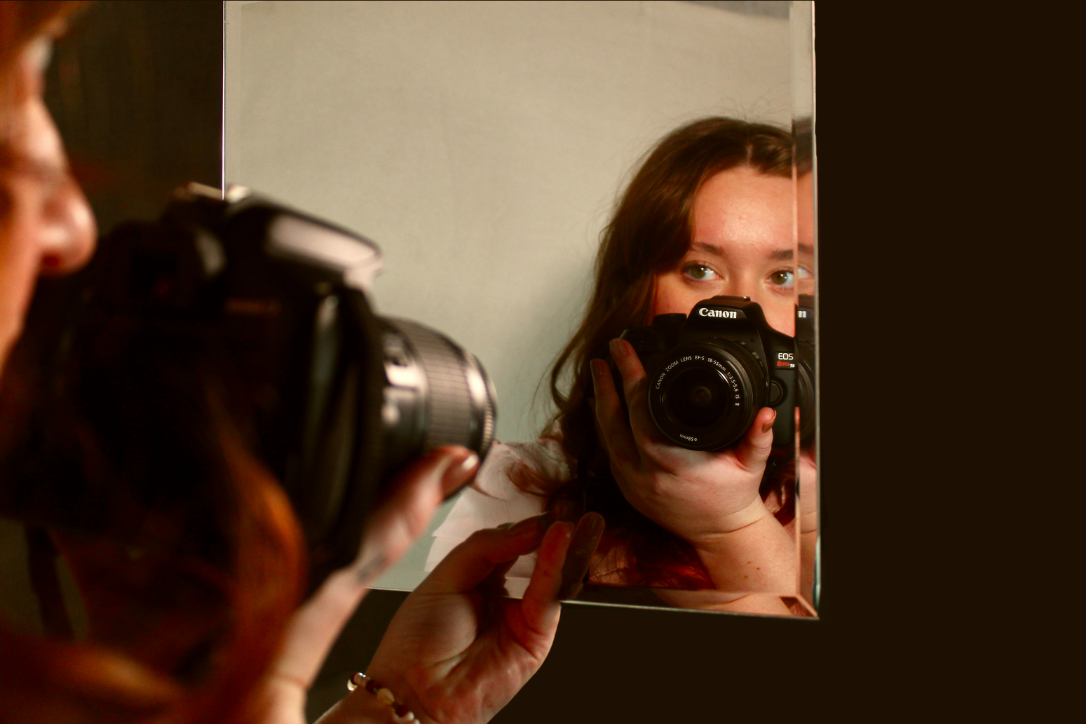

“To collect photographs is to collect the world.”1
Those words are inscribed on the first page of Susan Sontag’s 1977 essay On Photography. Her commentary discusses the cultural importance of photography and how the art form impacts our understanding of the world.
Photography does not look the same today as it did when Sontag wrote her essay 50 years ago. We are no longer collecting the world through photographs as Sontag once described; our control over the narrative has been lost. Photographs are now reshaping the way we see the world and our place within it.2
Visual literacy has changed since mobile photography was introduced. Academics are beginning to research the lasting influence of this culture shift and how interpersonal relationships may be impacted.
Megan Wood, PhD, joined the conversation to analyze the relationship between mobile photography and interpersonal interaction. The assistant professor of communication studies at Ohio Northern University draws upon Sontag’s commentary to express how modern photography practices can be traced to the 1970s: “… [Sontag] identified something structural about photography long before the smartphone existed.”
Sontag noticed a substantial shift in photography practice. What was once considered a skilled art form was suddenly commonplace for the average consumer; anyone and everyone was using photography in their social lives.3 The artistry behind photography was being replaced by the need to manage relationships and experiences.
“The family album, the vacation snapshot, the ritual photograph at the wedding, the selfie…these were all ways of asserting social belonging, or of proving that an experience was had or that bonds exist,” wrote Wood.
Social photography, as coined by social media theorist Nathan Jurgenson, is fundamentally different from the traditional practices we are familiar with. Photographs are becoming conversational rather than informational, artistic or professional.4 We now live in a culture where everyday pictures—selfies, sunsets, food, fit checks—play a role in how we communicate with one another. The long-term effects on our culture have yet to be understood.
“…[M]obile photography has become deeply integrated into the texture of everyday sociality, and we probably underestimate how much this changes the phenomenology of experience itself. There’s a real question in whether the reflex to photograph a moment changes how you inhabit it.” – Megan Wood, Ph.D.
Communication is becoming more visual, and that cultural shift is transforming how people connect. Pictures give us creative ways to express our identities, opinions and experiences. We must now consider how photography’s growing accessibility shapes our worldview.
“There’s an argument made pretty often that mobile photography has ‘democratized’ the visual: everyone has a camera now, everyone can produce and circulate images, the old gatekeepers of visual representation have been bypassed,” explained Wood.
Social media adds a layer of complexity to how we view the world as online platforms which broaden our exposure to pictures. As Wood describes, “images generate engagement; engagement generates data; data generates profit.” The content in our algorithms is carefully selected to drive engagement rather than show us what is real and authentic. Digitally shared photographs are not revealing more of the world, but showing a selective glimpse of it.
“Platforms don’t just transmit images neutrally, they algorithmically amplify some and suppress others, and the criteria for amplification encode some troubling assumptions about aesthetics, bodies, and ways of life that are anything but neutral,” wrote Wood, referencing Safiya Noble‘s research in algorithmic discrimination and oppression as an example.
The generations who have grown up with social media tend to have an intellectual imbalance: while many are well-versed in technology, there is a lack of visual literacy when it comes to the content they view. Worldviews can be drastically influenced by how images are interpreted online. We have yet to see the consequences of content being consumed without proper judgement.
“… I’d say social media has produced a generation of visually sophisticated consumers who are simultaneously underprepared for the harder analytical work that critical visual literacy requires,” said Wood. “Those aren’t the same thing, and confusing them is one of the more significant pedagogical problems we’re facing right now.”

Pictures serve a greater purpose beyond the limitations of social media. At its core, photography is an art form where creativity and imagination foster visual storytelling. Access to mobile photography has transformed both the quality and quantity of pictures publicly available, blurring the line between art and everyday life.
Emily Jay, PhD, has witnessed firsthand how photography evolves generation to generation. The assistant professor of art at Ohio Northern reflected upon learning photography on her dad’s Pentax film camera and noted her preference for the now-vintage equipment. Jay found through experience that the artistry behind photography does not change as cameras evolve. Artists are now challenged to find their niche in the ever-changing world of photography, whether that be with mobile phones or traditional equipment.
“I suppose I feel that phone photography is here to stay,” wrote Jay, “so if it ‘hurts’ the discipline, that’s just laziness on the part of artists—we have to rise to the changes in the world and continue to push ourselves and make excellent, beautiful, compelling, and challenging artwork.”
The line between photography as art or documentation has been blurred for a long time. Jay noted how artists used to distinguish their work, writing, “[e]arly on, the artists who wanted photography to be considered art worked really hard to assert that it was art, because not everyone saw it as such.” She described how exhibitions, publications and creating “painterly” images were strategies used to assert artistry in photography.
To the chagrin of some artists, photography has long served as a tool for documentation. Pictures preserve moments in time regardless of the intention behind it. Smartphones now make it harder to distinguish whether a photograph is being used as art or to merely document life.
“I bring up both of these things together to say that photography has always been both—both art and documentation. I think, and this is absolutely my own belief, that all art is documentation, of life, of experience, of something. So, the line was already blurred, and now mobile photography is blurring it further!” – Emily Jay, PhD
Cameras don’t just show us the world; they allow us to be fully present within it. Unlike smartphones, mirrorless and film cameras give power to the beholder. The photographer can adjust the settings, such as exposure, depth of field, focus and shutter speed. Every detail is meticulously noted by the photographer to create an image with intent and purpose.
“This doesn’t mean I think taking photos with phones is a bad thing, or that you can’t make good photos with phones. That’s far from the case!” explained Jay. “I use my phone camera for all sorts of things, and love many of the photos I take with it. But it doesn’t let me be present with the world in the way that a traditional camera does—I don’t have the ability to be slow and think critically about what is in front of me while adjusting what my camera is doing.”
Jay offers two perspectives to consider as photography becomes easier to access. First, there is a misconception “that to experience [an] event you must photograph it.” She explains how pictures are not necessary to experience life, even though taking them is a common trend. Another perspective Jay addresses is how limiting our ever-growing access to photography truly is.
“… [T]here is the assumption that we can see everything, and that everything we see is ‘real’,” wrote Jay. “That the whole world is accessible to us, thanks to all the photos that are taken, that we can look up anything and see it. But that is not the case—a photo is just a single, tiny slice of time and space and even in the moment that it captures it does not capture the fullness of that moment.”
Mobile photography’s influence on our worldviews is too complex for a single article. The constant stream of pictures we share and receive have shifted our communication style and transformed what it means to be visually literate. Moreover, smartphones have brought into question what it means to be an artist in the digital age. As research continues and creatives reevaluate their field, we must consider the media we consume and evaluate how it shapes our place in the world.
- Susan Sontag, On Photography (Picador, 2001), 1. ↩︎
- “How mobile photography is reshaping cultural storytelling worldwide.” British Journal of Photography, 1854 Media, 22 Dec. 2025, http://www.1854.photography/2025/12/how-mobile-photography-is-reshaping-cultural-storytelling-worldwide/. ↩︎
- Susan Sontag, On Photography, 8. ↩︎
- Nathan Jurgenson, The Social Photo: On Photography and Social Media (Verso, 2019), 8. ↩︎