

This article was written by Michael Kirchner and Gabriel Mott.
Every community needs “third places.” Somewhere connections are born, laughter is exchanged, and memories are made. These places are vibrant social landscapes. But amidst the blurred lines of home, work, and study in college, does Ohio Northern University (ONU) have a “third place” for its students?
Sociologist Ray Oldenburg, who coined the term third places believes that they are a key part of a vibrant community. This concept primarily describes certain areas within a geographic community where people gather in public places. As the name suggests, there are first and second places as well. The first place is the home, while the second place is work or school. A third place is a place often separate from the two where people go to interact with others. These places are supposed to be where people share ideas and build relationships.
The concept of a third place can be tied to other concepts in sociology, especially surrounding theories of community. “Bowling Alone” by Robert Putnam is an example of a book that traces the history of communities using similar concepts. Similarly, historians have argued that taverns provided the space where America’s founding fathers birthed the American Revolution.
We asked Keith Durkin, Professor of Sociology at ONU, about the importance of third places, and he said, “I think they are important to the human experience; they are a source of social integration and a solution to loneliness/alienation”
It is particularly imperative to the nature of college life to cultivate strong third spaces; the work/life balance is necessarily blurred by the conflation of the first and second spaces for many students. Both are, generally speaking, a college campus. Especially when classes and meetings occur next door to dining and recreation (i.e., “home”), these spaces no longer feel distinct for many students.
Of course, this problem is not circumvented by the inclusion of third spaces, which may themselves be conflated in the same manner; indeed, many friends are made through academics and work-study in the college setting.
The Library, for instance, could be a place where students regularly meet and socialize, but this can be overshadowed by its use as a study space.
The McIntosh Center similarly has spaces designed for conversation
We asked Durkin whether he felt that ONU provided enough third places for students on campus. “I absolutely believe that ONU is doing a good job of providing possible third spaces (e.g., Starbucks, the Student Center, King Horn). However, people need to utilize these third spaces —- it is a physical space where other humans are physically present. I think social media is a reason people don’t utilize them.”
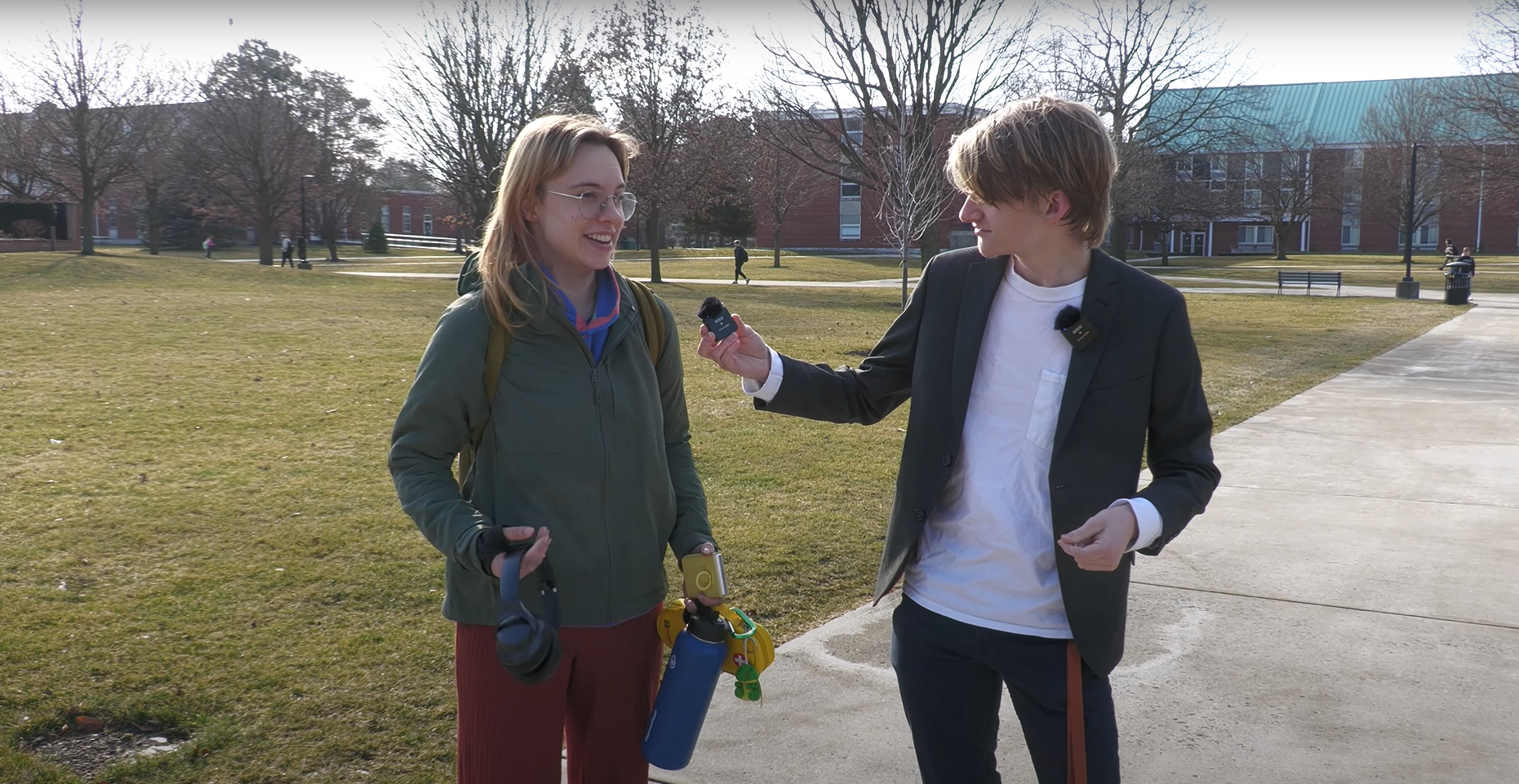
We asked ONU students what their third places are around campus. This is what they told us:
Ty Sherrick’s third place is the Engineering building, “…that’s where the work gets done for me.”
Finn Price’s third place is a friend’s room, “My friend has this amalgamation of desks in his room, and we’ve accumulated all of our chairs there, so we all just sit there and play video games together.”
Churches serve as a third place for Wesley Casselman, “I usually go over to Our Lady of Lourdes Catholic Church in Ada, and I hang out there, that’s where I meet most of my friends.”
Alexa Clampitt uses the library as her third place, “The library, that’s where I see the most people.”
This seems to confirm that there are some good third places on campus and in the wider area, as Durkin claimed. However, Alexander Cressley, Applied Statistics, ONU ‘22, noticed that there was a stark contrast between the utilization of places like Wow before and after the COVID-19 Pandemic. He said “Students would hang out at WoW almost every day to get food and snacks, mostly chicken tenders, and play pool next door. Dine-in was standard and people would meet up, and there was almost always someone playing pool or ping-pong. Wow was the preferred place to use the meal plan if you wanted better quality food vs the Dining Hall. It was open late into the night, which allowed for late night ventures to get food when the dining hall was not open.”
The pandemic, therefore, seems to have majorly disrupted the usage of certain third places, like Wow, with students no longer using these spaces as frequently or as intensely as they once did. Many students today will take Wow on the go rather than hang around as they would have before the pandemic.
[…] “Beyond Dorms and Lectures: The Role of Third Spaces in College Life” by Michael Kirchne… […]