

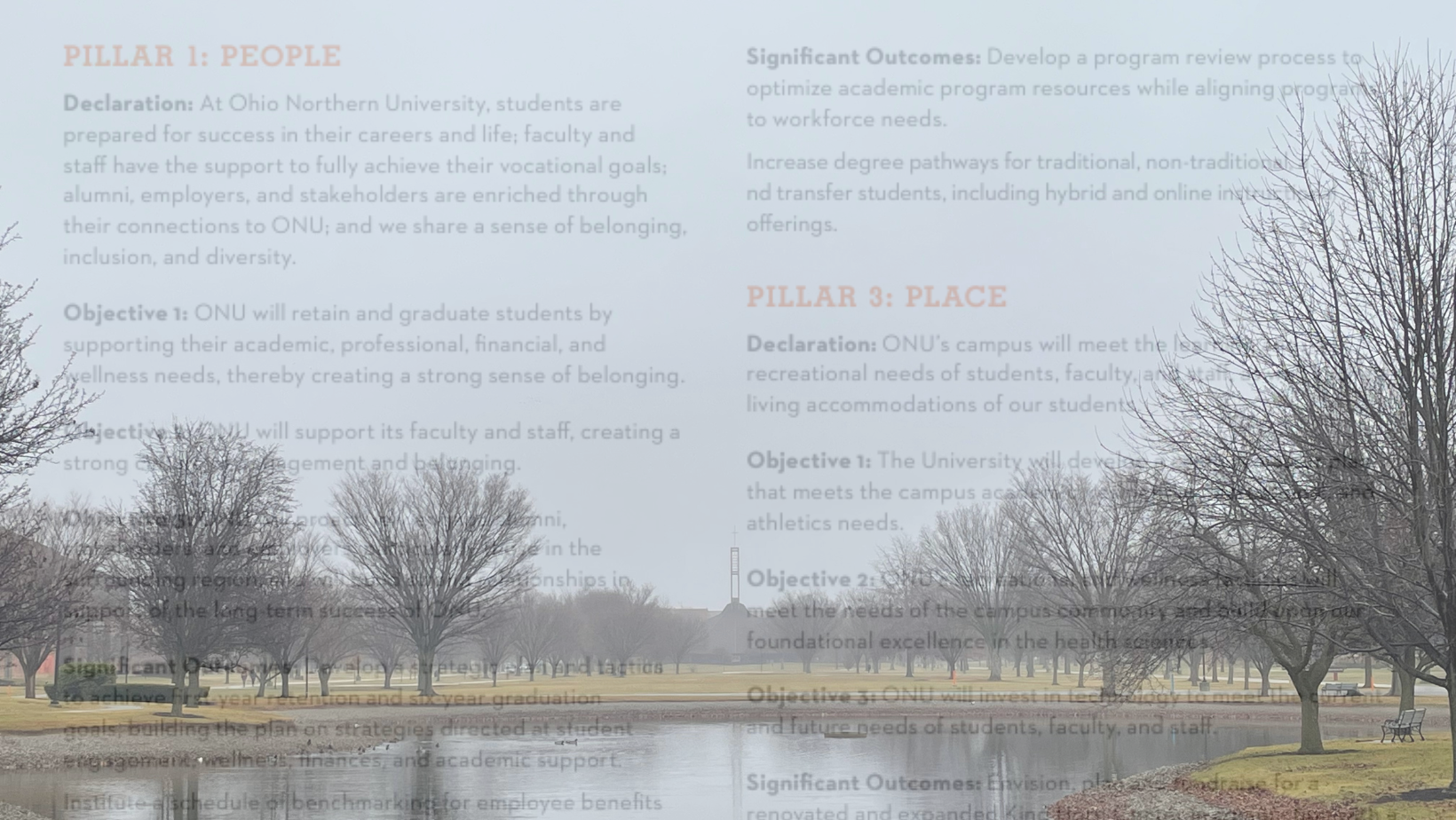

Last semester, Ohio Northern University’s administration released a “Strategic Plan,” which promises to steer the university into the future and provide the student body with the transparency it’s been rightfully demanding. There’s only one problem: it’s wholly insufficient. The “Master Plan” contains most information of relevance to the students, and it will likely never see the light of day. In the past, the university’s master plan wasn’t available to some faculty and administrators, much less the student body, hence the miscommunications that led to the Hill Memorial fiasco.
One argument often used in defense of this opaqueness is that the administration has no choice because of the competitive and tightening college market. Additionally, Ohio Northern is a private university, leaving the administration with much more information security than public schools. Here, a distinction between legal and moral obligations may be useful; while ONU cannot be forced into providing more transparency with the student body, we can argue it is nevertheless a reasonable expectation of the student body, on the grounds of respect and honest practices. It might be useful to consider other universities’ strategic plans or strategic plan equivalents to identify a level of transparency that could be viably provided to the Ohio Northern student body. In the interest of fairness, all of the following cases come from small, private liberal arts universities.
Otterbein University Strategic Plan
I was unable to recover a copy of this plan from the university itself. Still, its coverage through student media necessitates that it was either made available to the student body or the student publication directly, either of which would represent an increase in availability relative to Ohio Northern.
In terms of specificity, this plan identifies two locations on campus for development: a newly acquired plot of land and an extension to their existing Engineering building. Stronger Together calls for an expansion of Kinghorn as its only concrete campus improvement item, but without access to Otterbein’s plan, levels of detail could not be compared.
John Carroll University Strategic Plan
Again covered by student media, the full document was made available to all faculty and staff, again beyond Ohio Northern’s level of accessibility. Rather than campus improvements, the content of the plan given focus by student media concerns academic restructuring due to “fall[ing] behind” other universities. ONU’s strategic plan has generally taken a more optimistic tone. However, we would falter in assuming ourselves above the impact of the ongoing enrollment dip. If such a pivot were necessary, I would hope we can be as transparent.
This 2014 Master Plan was found as a publicly available file on Kenyon College’s website and includes significant details on the institution’s future. Renovations to existing buildings and entirely new buildings alike are laid out in stunning detail, including floor plans and architectural renders. Admittedly, this is in service of a more fanciful goal, speaking in terms of what “would” happen if these changes come to fruition rather than feeding our accustomed certainty that they will. Still, I think ONU would benefit from being as open about undecided, high-concept matters.


One other thing I appreciate about this plan is that it incorporates the previous master plan for context and thoroughness (this 2014 master plan mentions the 2004 master plan). Unless we get an unsealing of Ohio Northern’s 2014 master plan in time for 2024, this may be a precedent we cannot set for another ten years, but I believe it would be a valuable one nonetheless.
The College of Wooster Master Plan
From 2012 (student media reports revision to the plan is occurring as of 2019, but I could not find an updated version), this master plan is available through the university’s website. Like with Kenyan, this plan’s tangible items take the form of “Recommendations” rather than certainties for the future. I’d like to make the case that a combination of both would be best for Ohio Northern’s ‘24 plan. Although mere recommendations, this document contains some of the most specific detail in identification of actionable items of all of the campus plans I have reviewed, and would strongly recommend ONU attain the same level of specificity.
This plan was developed by the Dober Lidsky Mathey architectural group, which has done campus planning for several other private schools (several plans are available through the architectural group, but not through their universities). Last semester, Ohio Northern brought BDHP Architects in for a pair of student feedback sessions. It is unclear whether this group will author ONU’s ‘24 master plan, but any materials approved by the Board of Trustees should be done with the architects’ input.
Ohio Wesleyan University “Vision for the Future”
This plan for Wesleyan’s future was published in 2016 and remains published as a publicly available page of the University’s website. Although these items have since transpired, at the time it was published the plan forecasted the creation of five new majors, the purchase of new student monitoring software, identified areas for future campus development, and announced a fundraising campaign several months in advance.
Striking to me is the University’s candid admission of their faults; simple lines such as “To address the issue of student retention, which currently stands at 80.7 percent (compared with 85 percent or higher among peers according to U.S. News & World Report)” provide valuable context to the reader while owning responsibility for the institution’s future. I would hope that when ONU’s Master Plan comes out, it addresses head-on problems such as our loss of staff.
Cedarville University Master Plan
This master plan is again a section of the university’s website. In addition to a proposed campus map à la Kenyon College, this plan includes a Gantt Chart for project completion, shown below. In my opinion, this strikes a great balance between the uncertain optimism/speculation of large, fanciful goals with concrete deadlines and incremental goals to ground the campus’ development.

Ohio Northern would benefit from a timeline like this, and from President Baumann’s discussion, it seems the enigmatic 2014 plan may have had something similar. Regardless of form, one commonality we know this plan shares with ONU’s current documents is a longevity; even though most individuals reading this article, including myself, will have graduated Ohio Northern by the time some of the elements of the plan have come to fruition, we should have a vested interest in the long-term success of the university (both because it would harm us professionally to have the ONU degree devalued, and because of simple school pride and allegiance).
Wake Forest University Master Plan
This is the last plan I would like to consider, and admittedly, it is a little bit of an indulgence. This school is slightly larger than ONU and relatively far away, but it is, in my opinion, one of the best master plans from a private university which is made available on their website. Even if it may not serve as a valid analog for Ohio Northern, it is worth considering as a platonic ideal for campus planning.
Echoing the practices of previous plans, this document includes several annotated campus maps, considering the use of the surrounding community, open space, pedestrian circulation, and university land ownership. Detailed notes are also made as to material use and architectural style for future campus projects.
The plan is broken into three phases, the second two with slightly more ambitious goals, with a range from repaving roads to extensive building renovations. The master plan explicitly notes that “early implementation of Phase I is based on the currently planned facilities in the University’s Strategic Plan. The order of projects identified in Phase II and III is based on current knowledge, but should be considered a theoretical exercise to demonstrate potential implementation.” It could be of use for Ohio Northern to include both certain and theoretical goals for a more complete picture of the university’s likely future.
As a complement to campus development, academics are also considered in this plan. Much of this consists of campus development which focuses on better facilitating academic functions, but some more general pedagogical practices are considered, such as the “ departmental stewardship” of classroom spaces.
Finally, I will note that this plan’s development considerably solicited the input of “ stakeholder groups” –Academic, Athletic, and Student Life committees as well as the Board of Trustees, faculty, staff, and students en masse. This is one item on which I can praise President Baumann’s current redevelopment approach–although the university has long-term goals outside of (or even in contradiction with) students’ immediate wishes, we are still the ultimate subjects of the goods Ohio Northern provides as an institute of higher education, and our input should be sincerely valued and considered.
A plan of this caliber may not be reasonably expected of Ohio Northern due to general differences of circumstance, but I sincerely hope that a good faith attempt is made by administration to adhere to best practices in developing the master plan with the student body in mind, and being subsequently transparent about their results. Some of President Baumann’s comments have been promising, but only time will tell.